

Did you know that one of the most important financial decisions you make isn’t just about your retirement – but about protecting the people you love most? Social Security is often thought of as a personal benefit, but in reality, your Social Security strategy can often impact the financial future of your spouse, former spouse, or surviving family members.
Understanding the nuances of Social Security’s spousal, survivor, and divorce benefits can help you make more informed, confident decisions. With the right strategy, you’re not just planning for retirement; you’re creating a financial safety net for the people who matter most.
Spousal Benefits:
In order to be eligible to receive your own Social Security benefits, you must have earned 40 “credits,” which generally requires a minimum of 10 years of work.
But what about those who have not reached that requirement—whether because they did not earn enough to be covered or were a stay‑at‑home parent? Covered or not, you may still be considered eligible for benefits. The Social Security Administration calculates a benefit for qualifying individuals known as a spousal benefit.
Whether or not someone has met the minimum working requirement, they may be eligible for a spousal benefit if all of the following apply:
- You are at least 62 years old
- You have been married for at least one year
- Your spouse has filed for their own Social Security.
The portion of your spouse’s full benefit that you can receive depends on when you initiate spousal benefits.
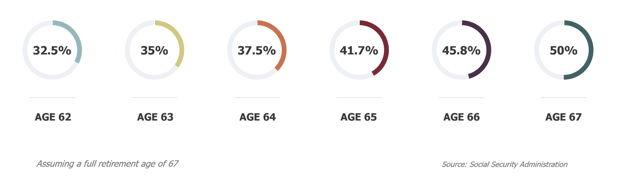
As you can see from the figure above, like individual benefits, spousal benefits will be reduced if you collect before your FRA.
Only one spouse in the partnership can claim spousal benefits. If you file before your FRA, you get the greater of your benefits or your spousal benefits – not both!
Survivor Benefits:
At some point, one spouse may pass before the other. Along with the emotional toll, this loss can bring financial uncertainty, especially if the deceased spouse was the primary earner. To help provide support during this time, the Social Security Administration provides survivor benefits to eligible widows and widowers.
To qualify for survivor benefits, you must have been married for at least nine months before your spouse’s passing. In most cases, you can begin receiving these benefits as early as age 60. However, like other Social Security benefits, starting early will result in a reduced monthly amount.
If you wait until your Full Retirement Age (FRA), you can receive up to 100% of your spouse’s benefit. This includes any increases they earned by delaying their own benefits. If your spouse passed away before claiming Social Security, you would still be eligible to receive their full Primary Insurance Amount (PIA) at your FRA.
It’s important to understand that you cannot receive both your own benefit and a survivor benefit at the same time. Strategy and timing will determine which benefit is most appropriate for your situation. For example, you might choose to start a reduced survivor benefit at age 60, then switch to your own full retirement benefit later. This strategy can help maximize your total lifetime benefits.
What happens if you remarry? The timing matters. If you remarry before age 60, you generally won’t be eligible for survivor benefits based on your previous spouse’s record. However, if you remarry at age 60 or later, your survivor benefits will not be affected.
Divorce Benefits:
If you are divorced, it’s still possible to receive spousal or survivor benefits based on your ex-spouses work record, under a few conditions:
- You must have been married for at least 10 years
- You must be divorced for at least 2 years
- You are at least 62 years old
- You are unmarried
- And your ex-spouse is entitled to Social Security benefits.
While your ex-spouse must be entitled to receiving benefits, you do not need to wait until they claim for you to begin collecting benefits for yourself.
Understanding your Options
Social Security decisions can become more complex when spousal, divorced, or survivor benefits come into play. While there’s no one-size-fits-all approach, understanding the rules can help you assess your options to determine what is right for you.
To learn more about the nuances of Social Security and how to potentially get thousands more in your retirement pocket, join us for our upcoming webinar – Navigating Social Security Strategies to Maximize Benefits.

